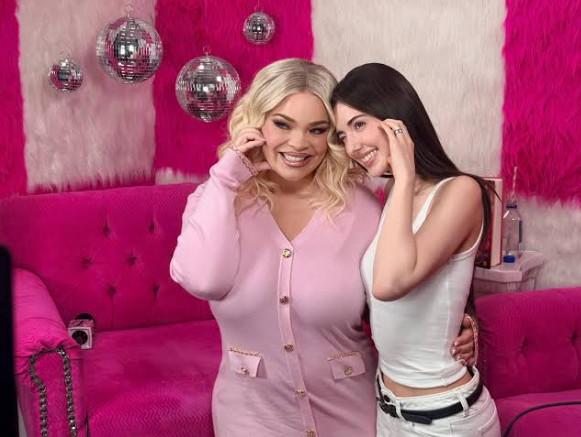
Honestly, this was not the crossover most people had on their 2026 bingo card.
Rachel Kwon recently appeared on Just Trish, the podcast hosted by Trisha Paytas, and the collaboration immediately had people questioning how these two ended up sitting across from each other in the first place.
It is an especially interesting pairing because Rachel Kwon and Trisha Paytas have cultivated very different public images.
Rachel’s brand has generally leaned heavily into lifestyle, beauty, femininity, Korean culture and her relationship with her Korean husband. Her content is polished and carefully packaged, with a much softer image than the chaotic, controversy-driven persona that Trisha Paytas built over the course of her internet career.
Trisha, meanwhile, has spent nearly two decades at the center of internet drama.
So when Rachel Kwon and Trisha Paytas suddenly appeared together, people understandably had questions.
And judging by the reaction online, plenty of viewers were not exactly thrilled about the pairing.
Why Are Rachel Kwon and Trisha Paytas Even Collaborating?
That seems to be the biggest question surrounding Rachel Kwon and Trisha Paytas.
One Reddit thread about the collaboration was literally titled, “What are Rachelhehehe and Trisha Paytas doing together?”
The original poster called it a “random crossover” and said they did not expect Rachel to collaborate with Trisha.
That sentiment was repeated throughout the discussion. One commenter simply described it as the “weirdest and most unexpected crossover ever,” while another responded with a blunt “wtf.”
It is easy to understand why.
Influencer collaborations usually make some degree of sense. Two creators share an audience, have similar content, are promoting something together or simply exist within the same social circle.
Rachel Kwon and Trisha Paytas do not immediately look like an obvious match.
Which, of course, may be exactly why the collaboration is getting so much attention.
Commentary: Why Would Rachel Kwon Collaborate With Someone So Controversial?
This is where the Rachel Kwon and Trisha Paytas collaboration becomes more interesting than simply another podcast appearance.
Rachel has spent considerable effort cultivating a particular image online. Her content is polished, feminine and heavily centered around her life in Korea and her relationship. Whether someone likes that brand or finds it excessive, it is recognizable.
Trisha Paytas represents almost the complete opposite end of the influencer spectrum.
Her brand was built around controversy, oversharing, trolling, public feuds and deliberately provocative content. She has spent years being criticized for offensive statements and behavior, only to eventually reinvent herself and become a more mainstream internet personality.
That contrast is enormous.
So why would Rachel Kwon choose Trisha Paytas?
There are several possible explanations, and none of them necessarily require some dramatic conspiracy.
The simplest answer is exposure.
Trisha has an enormous amount of experience turning podcast appearances into viral clips, and Just Trish has become a major platform within influencer culture. For someone like Rachel, appearing on the podcast potentially puts her in front of an audience that may not otherwise encounter her content.
There is also the possibility that Rachel simply does not view Trisha in the same way that her critics do.
People can have very different opinions about public figures. Someone who remembers Trisha primarily for her most notorious controversies may see the collaboration as bizarre, while someone who watches Just Trish regularly may see her as a successful podcaster who has moved into a different phase of her career.
And then there is the most cynical explanation.
Drama sells.
Rachel Kwon and Trisha Paytas appearing together is interesting precisely because it is unexpected. The fact that people are asking why they collaborated is itself generating conversation, posts, comments and views.
From an influencer-business perspective, that is not necessarily a bad thing.
The stranger the pairing, the more people want to know what happened.
Reddit Was Not Exactly Celebrating the Rachel Kwon and Trisha Paytas Crossover
The reaction on Reddit was considerably more skeptical than celebratory.
One commenter mocked Rachel’s content by writing, “that’s the chick who makes her Korean husband her whole personality.”
Another commenter took that criticism even further, describing the relationship as “borderline obsession” and making claims about the couple’s history in the Korean entertainment industry.
Those claims are Reddit users’ opinions and allegations, not independently established facts, but they demonstrate the type of criticism Rachel already receives online.
Another commenter went in a different direction, arguing that some non-Korean women who prominently center their Korean husbands online are participating in a fetishization of Korean men.
Again, that is a commenter’s characterization rather than an established fact about Rachel herself.
But it does reveal something important about her audience.
Rachel’s relationship and Korean identity are such a significant part of her online brand that even a completely unrelated collaboration with Trisha Paytas immediately became another opportunity for people to debate the way Rachel presents herself.
Some Viewers Were More Concerned About Trisha
Other Reddit users were not focused on Rachel’s content at all.
They were focused on who she had chosen to collaborate with.
One commenter wrote that they were “so sick of the Trisha support,” while another said they had unfollowed Rachel after seeing the collaboration.
That reaction is significant because it suggests some people view collaborations as endorsements.
Rachel may not see it that way.
Her audience apparently does not universally agree.
For some viewers, there is a difference between watching Trisha’s podcast and actively choosing to sit down with her for an episode.
That distinction is at the heart of much of the criticism.
The Comment Section Also Accused Rachel of Deleting Criticism
Several commenters speculated that negative comments were being deleted from Rachel’s social media following the collaboration.
One person wrote, “I feel like she’s deleting negative comments,” while another replied, “Yeah 100% deleting comments.”
There is an important caveat here: the Reddit discussion does not establish that Rachel actually deleted comments.
That is speculation from commenters.
Still, the fact that people were discussing moderation at all shows how quickly the collaboration became controversial among portions of Rachel’s audience.
And if negative comments really were being removed, that would only make people more curious about what was being said.
Nothing makes an internet audience want to find a supposedly deleted comment more than telling them it disappeared.
Some People Just Thought the Collaboration Was Gross
Not every Reddit commenter bothered with a lengthy explanation.
Some simply hated the pairing.
“all shade, all tea ☕️ gross,” one commenter wrote.
Another said they were “off her now” after the collaboration, while also criticizing Rachel’s recent voiceovers.
Someone else joked that they briefly mistook Trisha for Kylie Jenner.
Even the comments that were not particularly serious contributed to the same overall reaction: people were surprised that Rachel Kwon and Trisha Paytas were suddenly sharing a microphone.
And surprise is exactly what makes an unexpected influencer crossover interesting.
Trisha Paytas Has A Very Long History of Controversy
Of course, the reaction makes more sense when you understand Trisha Paytas’ history.
Trisha’s controversial reputation did not appear overnight.
For years, she built an audience by deliberately provoking people. Her content has included racist and racially offensive material, controversial statements about religion, mental health controversies, public relationship drama and an endless succession of internet feuds.
Some of those incidents are old.
Some resulted in apologies.
Some have been revisited repeatedly as Trisha’s public image changed.
But they remain part of her public history.
That is why Rachel Kwon and Trisha Paytas is such an interesting combination. Rachel is not simply collaborating with another lifestyle creator who happens to have a podcast. She is appearing on a platform belonging to one of the internet’s most historically controversial personalities.
The “It Was Just Trolling” Defense
One of the longest-running defenses of Trisha’s older content is that she was trolling.
And there is truth to the fact that trolling was a major component of her early online persona.
But calling something trolling does not automatically make it harmless.
Trisha’s strategy often involved taking an inflammatory subject, pushing it as far as possible and then capitalizing on the outrage that followed.
The backlash became content.
The response to the backlash became more content.
And eventually, the entire controversy became part of the entertainment cycle.
It was an extremely effective business model.
It was also one that generated a very long list of people who were offended, angry or simply exhausted by her.
The Racist Content Controversies
Trisha has faced serious criticism over racist content and racial stereotypes throughout her career.
Past videos and incidents involving offensive representations of race have repeatedly resurfaced online, making this one of the most difficult parts of her history to simply dismiss as youthful internet behavior.
There is a major difference between making an ignorant comment and intentionally creating provocative content involving race because you know it will get a reaction.
That is why these controversies continue to follow Trisha.
Even when the content is years old, the internet archive has a habit of bringing it back.
The Antisemitism Controversy
Trisha’s comments involving Judaism and Ethan Klein became another major controversy during the Frenemies era.
The situation led to accusations of antisemitism and eventually an apology from Trisha.
Again, acknowledging the apology does not require pretending the controversy never happened.
People can change.
People can regret things.
People can also continue to be criticized for things they previously said.
All three statements can be true at once.
The JonBenét Ramsey Controversy
Then there is the JonBenét Ramsey controversy, which remains one of the most disturbing examples of Trisha’s old shock-value content.
Trisha created content involving the murdered child, including dressing up as JonBenét and referencing the case for entertainment.
The problem here is obvious.
JonBenét Ramsey was a real child who was murdered under horrific circumstances.
Turning a real child’s death into provocative internet content is going to make many people deeply uncomfortable, regardless of whether the creator intended it as trolling.
This is one of those controversies that is difficult to look back on and understand how it ever seemed like a good idea.
The DID Controversy
Trisha’s content surrounding dissociative identity disorder also generated enormous criticism.
She publicly claimed to have DID and created videos around the subject, which resulted in backlash from viewers and people who live with the disorder.
Critics argued that the condition was being treated more like an online persona than a serious mental health disorder.
Whatever someone’s personal conclusion about that controversy may be, the criticism again centered around the same fundamental question that has followed Trisha for years.
At what point does provocative content stop being entertainment and start trivializing something serious?
Then There Was Jason Nash
Trisha’s relationship with Jason Nash produced another lengthy period of internet drama.
Their relationship became content, and eventually their breakup became content too.
Personal arguments were discussed publicly, other members of the Vlog Squad became involved and increasingly private details ended up being consumed by an audience.
This was one of the clearest examples of Trisha’s tendency to turn relationships into entertainment.
When things were good, viewers got to watch.
When things went wrong, viewers got to watch that too.
And when everyone started fighting, the audience got front-row seats.
The Sean Van Der Wilt Controversy
Trisha’s relationship with Sean Van Der Wilt also generated controversy, particularly surrounding public discussions of his sexuality after their relationship ended.
Sexuality is an incredibly personal subject, and publicly discussing someone else’s identity can have serious consequences.
It is one thing to tell your own story about a breakup.
It is another to make another person’s sexuality part of that story.
The controversy became another example of how Trisha’s personal relationships could quickly become public internet narratives.
Frenemies Changed Everything
Then came Frenemies.
The podcast with Ethan Klein became one of the biggest influencer shows on the internet, largely because the chemistry between the two hosts was chaotic enough to make every episode feel unpredictable.
But that same chaos eventually became the show’s downfall.
Their arguments became content.
Their personal problems became content.
Their family problems became content.
Eventually, their disagreements over the podcast itself became the content.
Then the podcast ended.
The fallout became even bigger than the original argument.
The Five Percent Meltdown
The final Frenemies dispute remains one of the most famous influencer meltdowns of the YouTube era.
The argument involved production, finances and the allocation of five percent of the show’s revenue.
Trisha walked away from the podcast.
The show ended.
Then both sides began explaining their versions of what had happened.
Fans picked sides, old clips resurfaced and the internet spent weeks dissecting every detail.
Today, Frenemies is often remembered for the funny moments, costumes and chaotic energy.
The actual breakdown of the relationship is considerably less cute.
And Then Colleen Ballinger Happened
Trisha’s friendship with Colleen Ballinger produced another strange chapter.
The two eventually launched Oversharing with Colleen & Trish, but the podcast lasted only three episodes before the Ballinger controversy exploded.
Trisha later publicly distanced herself from Ballinger after messages involving the sharing of Trisha’s OnlyFans content became public.
The situation was particularly uncomfortable because privacy became the issue.
This time, Trisha was not simply the person discussing somebody else’s drama. She was dealing with the consequences of someone else allegedly sharing her private content.
It was a reminder that internet drama can become considerably less entertaining when the person at the center of it is you.
So Why Rachel?
That brings us back to Rachel Kwon and Trisha Paytas.
Maybe Rachel simply wanted to do a podcast.
Maybe she wanted the exposure.
Maybe she genuinely enjoys Trisha’s content.
Maybe she sees the current version of Trisha very differently from the version remembered by her critics.
Or maybe the collaboration was simply too good an opportunity to turn down.
There is nothing inherently wrong with collaborating with a controversial person. Influencers are adults who can make their own professional decisions.
But audiences are also allowed to react to those decisions.
And that is what makes the Rachel Kwon and Trisha Paytas collaboration worth discussing.
Rachel has cultivated a very specific image.
Trisha has cultivated a very different one.
Putting them together creates an immediate clash between those two brands.
The Rachel Kwon Image Versus the Trisha Paytas Brand
Rachel’s online persona is much more polished and controlled than the chaotic image associated with Trisha’s earlier career.
That contrast is precisely what makes the collaboration feel so strange.
Rachel has spent years presenting a curated version of her life, particularly her relationship, beauty routines and experiences connected to Korea.
Trisha spent years doing almost the exact opposite.
She made oversharing into a profession.
She turned public conflict into entertainment.
She frequently blurred the line between private life and public content.
That makes Rachel Kwon and Trisha Paytas an unlikely pairing on paper.
Which, from a marketing perspective, may actually make it a very smart one.
Maybe the Unexpected Part Is the Point
There is another possibility that should not be ignored.
Maybe the whole appeal is that nobody expected Rachel Kwon and Trisha Paytas to collaborate.
When two creators have completely different audiences, putting them together creates curiosity.
People who follow Rachel want to know why she is there.
People who follow Trisha want to know who Rachel is.
And people who dislike either one have another reason to talk about them.
That is how influencer marketing works.
You do not necessarily need everyone to love the collaboration.
You just need people to click.
But Rachel Should Not Be Surprised by the Backlash
If Rachel Kwon and Trisha Paytas collaborate again, Rachel should probably expect some of this reaction to continue.
Not because she is responsible for Trisha’s entire history.
She isn’t.
And not because appearing on Just Trish means Rachel endorses everything Trisha has ever done.
It doesn’t.
But when you collaborate with a controversial figure, you are inevitably borrowing some of their audience and some of their controversy.
That is the trade-off.
Rachel gets exposure to Trisha’s audience.
Trisha gets access to Rachel’s audience.
And both get something else that influencers desperately need.
People talking about them.
The Internet Is Not Going to Forget the Trisha Paytas Archive
Trisha has successfully reinvented herself.
She is now a mother, a podcaster and a much more established mainstream internet personality than she was during some of her most controversial years.
But reinvention does not erase an archive.
The old controversies remain part of the public record.
The apologies remain part of the public record too.
So do the explanations, defenses and attempts to move forward.
People are allowed to believe that Trisha has changed.
People are also allowed to remember why she became controversial in the first place.
Those opinions can coexist.
So, Are Rachel Kwon and Trisha Paytas the New Unexpected Influencer Duo?
Probably not.
But the fact that anyone is asking the question says a lot.
The Rachel Kwon and Trisha Paytas collaboration was unexpected enough to make Reddit users stop scrolling and start asking how the two even connected. Some people found the crossover funny or simply strange, while others were genuinely upset enough to say they were reconsidering their support for Rachel.
Others were less concerned with the collaboration itself and more curious about what Rachel and Trisha were actually planning to do together. After all, this is such an unlikely pairing that people naturally want to know what the motivation behind it was.
And that last question may be the most important one.
Because Rachel Kwon and Trisha Paytas together is such an unusual combination that the collaboration almost sells itself.
You don’t have to understand it.
You just have to click.
And judging by the reaction, people certainly did.
Leave a Reply